Every few months, I come across some version of the same question:
Is podcasting dead?I understand where the question comes from.
There was a phase around the lockdown, and even immediately before and after it, when podcasts were pulling numbers that became difficult to ignore.
The format exploded.
More creators started podcasts. Celebrities started appearing on them. Founders wanted to be on them. Brands wanted to sponsor them.
And then, naturally, everyone wanted one.
Today, the numbers don't necessarily look the same.
I've seen podcasts perform extremely well, but I've also seen overall views become harder to get compared to that phase.
So I don't think the people asking whether podcasting is dying are completely wrong.
Something has changed.I just don't think it's people's desire to have or listen to conversations.
Almost Every Obvious Podcast Genre Has Been Explored
Think about the major podcast categories in India.
Business.
Spirituality.
Health.
Doctors.
Celebrities.
Cricketers.
Entrepreneurs.
Relationships.
Finance.
Self-improvement.
Almost every obvious genre has been explored in some form.
And many of them have been explored extensively.
The challenge for a new podcaster today isn't simply:
"What niche should I choose?"It's:
"What can I bring to this conversation that the audience hasn't already heard?"That's much harder.
There was a time when simply getting an interesting person in front of a microphone could itself feel novel.
Today, audiences have already watched hundreds of these conversations.
The novelty of the format has reduced.
And I think that's okay.
It just means the format has to evolve.
Even the Guest Pool Can Feel Saturated
There's another problem.
The same interesting guest can appear on five different podcasts.
Sometimes within a relatively short period.
By the time the fifth interview appears, what exactly are we going to ask that hasn't already been discussed?
But I don't believe we'll ever completely run out of guests.
New people will always emerge.
New industries will emerge.
People will have new experiences.
Existing guests will develop new perspectives.
So I don't think guest saturation alone can kill podcasting.
The bigger question is what the host does with the guest.
A Good Guest Cannot Save a Bad Host
This is something I increasingly believe.
The host matters far more than people sometimes realise.
Podcasting isn't about sitting opposite an interesting person and reading ten questions from a sheet.
The host has to represent the audience.
If I'm watching a conversation and thinking:
"Ask him this!"the host should ideally already be thinking the same thing.
A good host listens.
They understand context.
They know when an answer needs a follow-up.
They know when to move forward.
They know when to challenge something.
They know when to stay quiet.
And most importantly, they need enough intellectual curiosity to take the conversation somewhere interesting.
That's difficult to fake.
You can have the best cameras.
The most expensive studio.
A famous guest.
Beautiful lighting.
But if the questions are vague and the conversation never goes beyond what I've heard the guest say twenty times before, why should I spend an hour watching it?
The guest may get the click. The host has to earn the watch time.Conversations Aren't Going Anywhere
This is why I hesitate whenever someone says podcasting is dead.
Because podcasts are ultimately just one technological version of something humans have always done:
Talk to each other.If I look specifically at our culture in India and across Asia, conversations have always been part of how we entertain ourselves, learn and exchange ideas.
Long before YouTube existed, people sat together and talked.
Then we listened to conversations and interviews on radio.
Television brought another version of it.
Even something like The Kapil Sharma Show, despite being entertainment rather than what we'd traditionally call a podcast, is fundamentally built around people sitting together, telling stories and having conversations.
Then YouTube and audio platforms gave us podcasts.
The technology changed.
The packaging changed.
The distribution changed.
But the underlying human behaviour didn't.
People like listening to people.I don't see that disappearing.
What I do see changing is how those conversations are packaged.
Maybe Audiences Have Found Other Ways to Learn
There's another possibility we don't talk about enough.
Maybe audiences aren't bored of conversations.
Maybe they simply have more alternatives.
If I want to understand a subject today, a 90-minute podcast isn't my only option.
I can watch a ten-minute YouTube video.
I can watch three Shorts.
I can read a newsletter.
I can search for an answer.
I can ask an AI tool.
I can follow someone who explains the subject every day on LinkedIn or Instagram.
The competition for a podcast isn't necessarily another podcast anymore.
The competition is every other way the audience can spend that hour.That raises the standard considerably.
A long conversation has to earn its length.
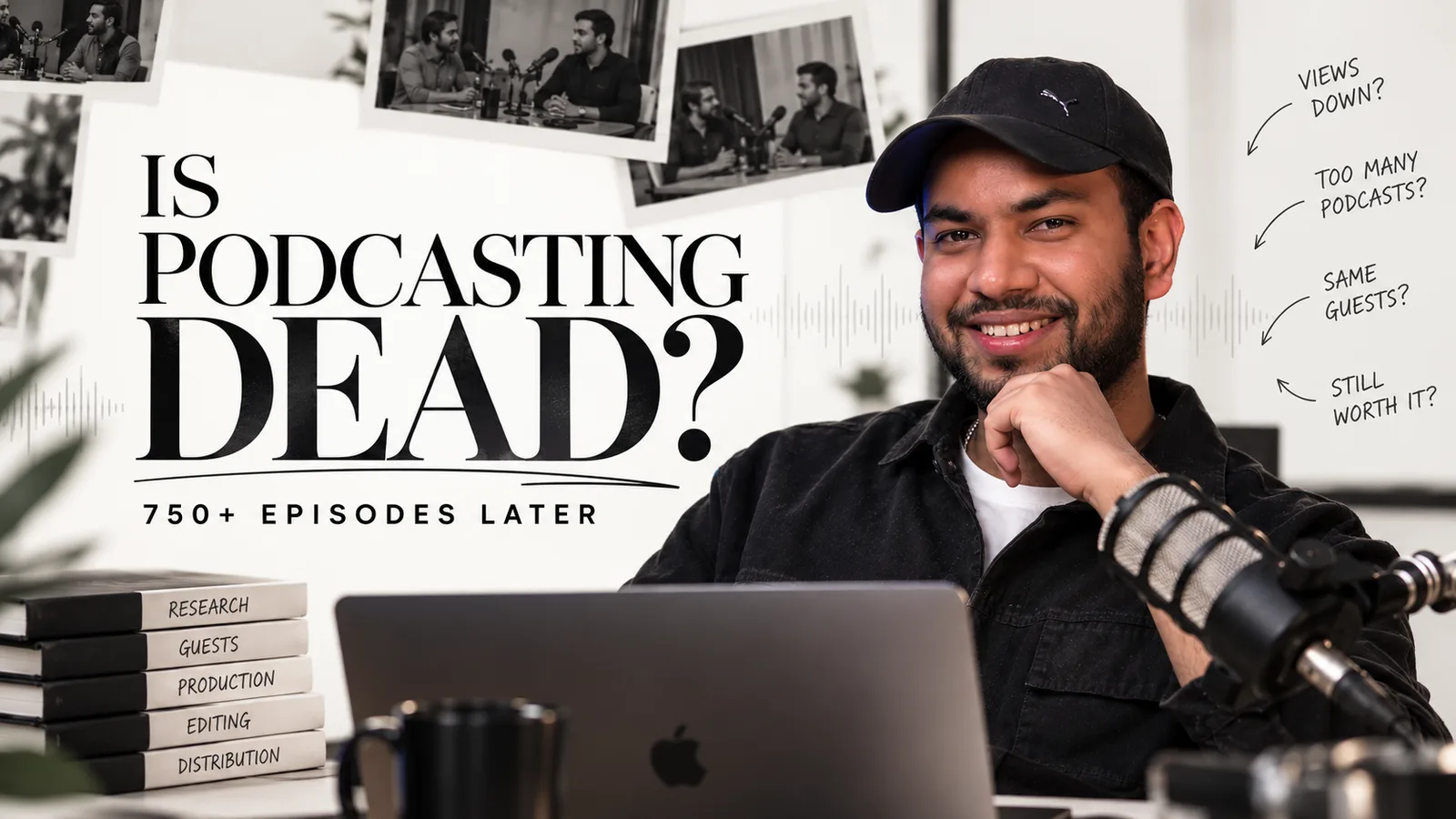
I've Worked Across More Than 750 Podcast Episodes. It Still Isn't Easy.
Over the years, I've worked on more than 750 podcast episodes in different capacities, on and off across clients and projects.
And I've pretty much touched every part of the process at some point.
Research.
Guest research.
Guest outreach.
Strategy.
Production.
Content cutting.
Shooting.
Camera.
Lighting.
Set preparation.
Editing.
Thumbnail and title packaging.
Social media.
Distribution.
Working across all these areas taught me something important:
Podcasting looks much easier from the outside than it actually is.The final product might be two people sitting opposite each other having a conversation.
But getting those two people into those chairs is only one part of the process.
There's guest identification.
Outreach.
Scheduling.
Research.
Pre-production.
Production.
Equipment.
Camera.
Sound.
Lighting.
The actual conversation.
Editing.
Content cutting.
Design.
Packaging.
Publishing.
Distribution.
And then analysing what happened.
It's a time-consuming and money-consuming content format when you want to do it properly.
People see two microphones.
They don't see the operation behind them.
I'll write separately about the entire podcast production process because that deserves an article of its own.
A Great Conversation Can Still Fail
This is probably one of the most humbling things about working in content.
I've been part of conversations where we finished recording and genuinely thought:
"This is a really good episode."And then it didn't perform.
It has happened multiple times.
That's because our perception of a good conversation and the audience's willingness to click and watch it are not necessarily the same thing.
Maybe the topic wasn't interesting enough.
Maybe the guest didn't have enough pull.
Maybe the packaging didn't work.
Maybe the timing was wrong.
Maybe we overestimated how much the audience cared.
That's content.
There is no equation where:
Good conversation = guaranteed views.And that's another reason I wouldn't judge the health of podcasting purely through individual view counts.
The Next Phase of Podcasting Needs Better Formats
I don't think the next breakthrough in podcasting will necessarily come from discovering some magical untouched category.
We may already have explored most of the obvious ones.
I think innovation will increasingly happen in the format itself.
Maybe the conversation doesn't always happen across a table.
Maybe episodes become more experiential.
Maybe podcasts borrow more from documentaries, entertainment shows or traditional television.
Maybe hosts build recognisable intellectual properties rather than simply naming the show after themselves and interviewing a different person every week.
Maybe the distinction between a "podcast", "show" and "YouTube series" becomes increasingly irrelevant.
And that's why I think asking:
"Is podcasting dead?"might be the wrong question.
The better question is:
"What does a conversation-based show need to become next?"Podcasting Isn't Dead. Average Podcasting Is Becoming Harder.
I don't think we are going back to a world where simply putting two interesting people in a studio guarantees attention.
There is too much content.
Too many podcasts.
Too many guests.
Too many alternatives competing for the audience's time.
That's the bad news.
The good news is that conversations themselves aren't going anywhere.
People will continue wanting to hear interesting people explain how they think, tell stories, disagree, teach and entertain.
But the bar is rising.
Hosts need to become better.
Research needs to become deeper.
Questions need to become sharper.
Production needs to become intentional.
Packaging needs to improve.
Formats need to evolve.
And the conversation needs to give me a reason to choose it over everything else available to me.
So no, I don't think podcasting is dead.
I think the era where simply having a podcast was interesting is ending.And what comes next could actually make podcasting much better.
More on Podcasting
Podcasting is much more than the final conversation you see on screen. From research and guest outreach to production, editing, content cutting and distribution, there is an entire operation behind every episode.
I'll be writing more about the production side of podcasting and how a single long-form conversation can become an engine for short-form content across multiple platforms.
If you're building a podcast, personal brand or content strategy and would like me to take a look at yours, get in touch.
Let's TalkWritten by Harsh Mengi, a content and social media strategist who has worked across 750+ podcast episodes spanning strategy, research, production, content cutting, packaging and distribution.