If you're trying to grow your personal brand or business on social media, at some point you'll probably ask yourself:
Who do I actually need to hire?A social media consultant? A social media manager? Or an entire agency?
They may sound like different versions of the same service, but they're not.
I've worked across different sides of this ecosystem over the years, from managing social media hands-on to leading social media and distribution for creator-led brands, working with content teams, and consulting creators and businesses on their content strategy.
And one thing I've realised is that businesses often start looking for people before clearly identifying the problem they need that person to solve.
A social media manager won't automatically fix a positioning problem.
A consultant isn't necessarily going to manage your Instagram account every morning.
And hiring an agency doesn't automatically mean you'll get better results than hiring one great person.
So instead of asking:
Who's better: a consultant, manager or agency?
I think there's a better question:
Where is my bottleneck right now: strategy, execution or capacity?
That's usually where the answer starts.
What Does a Social Media Consultant Do?
Think of a social media consultant as someone you bring in primarily for direction, diagnosis and strategy.
Maybe you've been creating content consistently for six months, but growth has plateaued.
Maybe you're getting views, but those views aren't translating into followers, enquiries or business.
Maybe your team is producing a lot of content, but nobody is quite sure what the larger strategy is.
Or maybe you're a founder who wants to build a personal brand and doesn't know whether to focus on Instagram, LinkedIn, YouTube or all three.
These are the kinds of problems I'd typically look at from a consulting perspective.
When I audit someone's social media presence, I don't start with:
"Why aren't you posting five Reels every week?"I start with more fundamental questions:
Depending on the situation, a social media consultant may help with positioning, content pillars, platform strategy, content formats, distribution, analytics, growth opportunities, monetisation and building a roadmap.
But there's an important distinction.
A consultant can help determine what should be done and why. That doesn't necessarily mean they'll be the person executing it every day.What Does a Social Media Manager Do?
This is where execution becomes much more important.
A social media manager is usually much closer to the day-to-day functioning of your social presence.
Depending on the organisation, their responsibilities could include:
But I want to clarify something here.
A good social media manager isn't just someone who posts content.I spent years working directly in social media management, and some of the most important decisions a strong social media manager makes are strategic.
Why did this Reel outperform everything else?
Should we repeat this format?
Is this topic becoming saturated?
Why did people click this YouTube video but leave after the first minute?
How should one long-form conversation translate into Instagram Reels, YouTube Shorts, Facebook and other formats?
What should we stop doing?
So the distinction isn't that consultants think while managers post.
It's more about where their primary responsibility lies.
A consultant is generally brought in for specialised strategic guidance.
A social media manager usually owns much more of the continuous execution and management.
What Does a Social Media Agency Do?
An agency starts making sense when the problem becomes bigger than what one person can realistically execute.
Instead of hiring an individual, you're hiring access to a larger team and a wider set of capabilities.
Depending on the agency, that could include:
For a company running multiple campaigns across several platforms, this can make sense.
Rather than separately hiring a strategist, designer, editor, copywriter and account manager, the company can work with one organisation responsible for multiple functions.
But there's another misconception worth addressing:
Agency doesn't automatically mean better.An agency could have incredible talent, but you still need to understand who will actually work on your account, how much senior involvement you'll receive, and whether the team genuinely understands your category.
The same principle applies to consultants and managers.
The label matters less than the quality of the people behind it.Social Media Consultant vs Social Media Manager vs Agency
Here's the simplest way I look at the difference:
Social Media Consultant
Primary role: Strategic direction Main problem solved: Clarity and strategy Typical engagement: Session, project or retainer Daily execution: Usually limited Strategic involvement: High Resources: Individual or small team Best suited for: Direction, diagnosis and problem-solvingSocial Media Manager
Primary role: Ongoing social media management Main problem solved: Consistency and execution Typical engagement: Usually ongoing Daily execution: High Strategic involvement: Varies depending on experience Resources: Usually an individual or part of an internal team Best suited for: Day-to-day management and consistent executionSocial Media Agency
Primary role: Broader execution across multiple functions Main problem solved: Capacity and scale Typical engagement: Project or retainer Daily execution: High Strategic involvement: Varies depending on the agency Resources: Multiple specialists Best suited for: Larger scopes requiring multiple capabilitiesThe easiest way to remember it is:
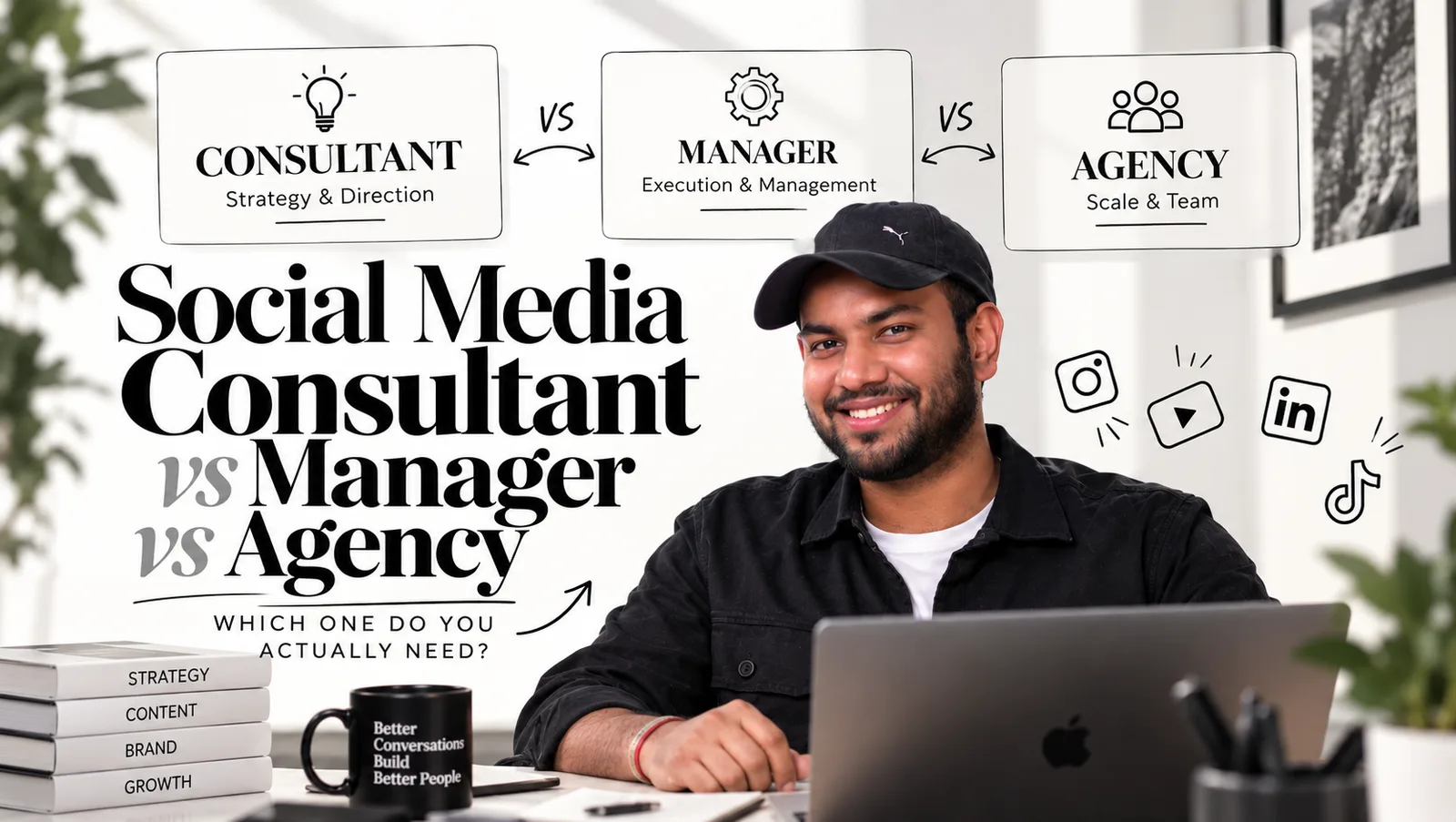
Consultant = Direction
>
Manager = Execution
>
Agency = Capacity
Of course, real-world roles overlap.
I've met social media managers who are exceptional strategists, consultants who are deeply involved in execution, and agencies that essentially operate as an extension of an internal marketing team.
So treat these as broad distinctions, not rigid definitions.
When Should You Hire a Social Media Consultant?
A consultant may make sense when you already have the ability to create content but don't know what direction to take.
For example:
In these situations, adding another person to your execution team may not solve the underlying problem.
You may first need someone to identify what actually needs fixing.
When Should You Hire a Social Media Manager?
A manager may make more sense when the strategy is reasonably clear, but execution is becoming the bottleneck.
Maybe you know what content you want to create but can't manage publishing every day.
Maybe your editor finishes videos, but nobody is coordinating what goes where.
Maybe content gets created but isn't distributed properly.
Or perhaps managing comments, calendars, collaborations, approvals and reporting is taking too much of your time.
That's where a strong social media manager can become extremely valuable.
You don't necessarily need more ideas. You need someone who makes sure the right things consistently get done.When Does a Social Media Agency Make More Sense?
An agency starts making more sense when the scope requires multiple capabilities at the same time.
For example, you might need:
Building all of that internally can require multiple hires and considerable management.
An agency gives you access to several capabilities through one relationship.
This can be particularly useful for organisations managing multiple brands, markets, campaigns or large volumes of content.
Sometimes the Right Answer Is More Than One
This is something that gets lost in comparisons like this.
You don't necessarily choose one forever.
A founder might work with a consultant to establish positioning and content strategy.
An internal social media manager can then execute that strategy every week.
An external agency might handle production or a specific campaign.
All three can coexist.
I've increasingly started looking at social media as a system rather than a job title.
Someone needs to answer:
What are we trying to achieve?Then:
What should we create to achieve it?And finally:
Who is responsible for actually making, publishing and distributing it?Sometimes one talented person can handle all three.
As the operation becomes larger, those responsibilities are usually divided across different people.
The Biggest Mistake: Hiring Before Diagnosing the Problem
If there's one thing I'd recommend before hiring anyone, it's this:
Figure out what is actually broken.
If your positioning is unclear, hiring three more editors won't fix it.
If your strategy is strong but you're publishing once every three weeks because nobody owns execution, another 50-page strategy presentation probably won't fix it either.
And if you're trying to produce 100 pieces of content every month, expecting one social media manager to strategise, shoot, edit, design, publish, analyse and manage the community isn't realistic.
Before hiring, ask yourself these five questions:
1. What specific problem am I trying to solve?2. Do I need strategy, execution or both?
3. What does success look like six months from now?
4. Which responsibilities will remain internal?
5. What exactly do I expect this person or agency to deliver?
Answering those questions before asking for proposals can save you a lot of time and money.
What Working Across Strategy and Execution Has Taught Me
My perspective on this comes from having worked on different sides of content and social media.
I've worked hands-on in social media management, led social media and distribution for creator-led content, worked with content teams and brands, and eventually moved deeper into content and growth strategy.
That experience has taught me something fairly simple:
Strategy without execution is just a document.
But the opposite is equally true:
Execution without strategy can make you extremely consistent at creating the wrong content.
The strongest social media operations connect both.
You know why you're creating something.
You know who it's for.
You know what you want the audience to do next.
You know how you're going to distribute it.
And someone actually owns making sure it gets done.
That's ultimately far more important than whether someone's LinkedIn headline says Social Media Consultant, Social Media Manager or Agency Founder.
Not Sure What Your Social Media Actually Needs?
If you're already creating content but aren't sure whether your biggest gap is positioning, content strategy, distribution or execution, that's exactly the kind of problem I work on.
I work with creators, founders, professionals and brands to review their existing social media presence, identify what's holding their content back and build a clearer strategy for growth.
If you'd like me to take a look at yours, get in touch.
Let's TalkWritten by Harsh Mengi, a content and social media strategist working with creators, founders and brands across content strategy, social media growth and personal branding.