
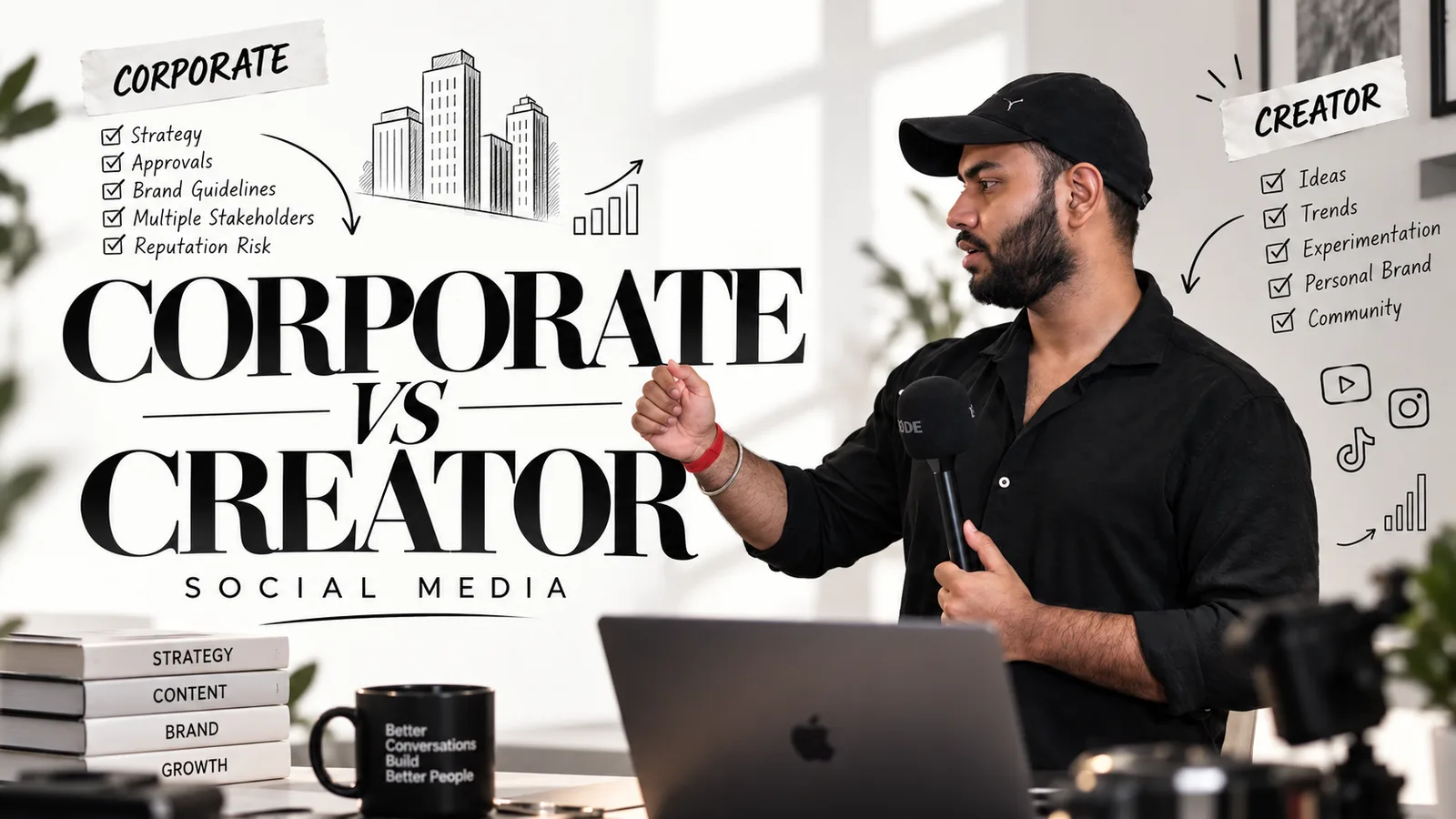
For a long time, most of what I knew about social media came from the creator ecosystem.
The approach was simple: move fast, experiment constantly, understand what people want to watch, and if something doesn't work, change it.
Then I started working more closely with corporate, B2B and enterprise content.
And I realised something.
Managing social media for a creator and managing social media for a corporate brand are two completely different games.A creator can ask:
"Will people care about this?"A corporate social media team often has to ask another question:
"Will people care about this, and can we actually say it?"Neither is necessarily easier.
They are difficult for completely different reasons.
1. With Creators, the Person Is the Brand
This is probably the biggest difference.
When you're managing social media for a creator, you already have something incredibly valuable: a human being.
Their face, opinions, experiences, humour, failures and personality are all potential content.
If a creator says:
"Here's the biggest mistake I made in my career..."
there is an immediate reason to listen.
There is a person behind the story.
Corporate brands don't automatically have that advantage.
A company can have incredible products, brilliant people and decades of expertise, but its social media can still feel distant.
That's why corporate content often needs to work much harder to create human connection.
The solution isn't necessarily to make a company behave like an influencer.
It's to find the people, stories and perspectives inside the organisation that audiences can actually connect with.
2. Speed Is Completely Different
Creator social media can move incredibly fast.
A trend appears in the morning.
You discuss it in the afternoon.
You shoot it.
You publish it.
Sometimes the entire approval process is one WhatsApp message:
"Post kar dein?""Yes."
Done.
Corporate social media can be very different.
Depending on the organisation and industry, a piece of content might involve marketing teams, leadership, brand guidelines, clients, communications teams or other stakeholders.
And there are legitimate reasons for that.
A creator is primarily responsible for their own reputation.
A company may be responsible for the reputation of an entire organisation.
One badly worded statement can have consequences far beyond one social media post.
But there is a trade-off.
The longer the distance between an idea and publishing it, the harder it becomes to participate in internet culture in real time.That is one of the biggest challenges corporate social media teams have to solve.
3. Creators Can Experiment More Aggressively
Creators can test.
Different hooks.
Different thumbnails.
Different formats.
Different opinions.
Different editing styles.
If something fails, the cost is usually limited.
The next piece of content might work.
This creates an environment where experimentation is naturally rewarded.
Corporate brands often have tighter boundaries.
Every experiment still has to feel like the brand.
That doesn't mean corporate social media cannot experiment.
It means experimentation needs a framework.
Instead of asking:
"Can we follow this trend?"I prefer asking:
"Is there a version of this trend that makes sense for this brand and its audience?"Those are very different questions.
4. Creators Have Personality. Corporates Need to Build a Voice.
Ask yourself why you follow your favourite creators.
It probably isn't because they have the world's best content calendar.
You follow them because you know what they sound like.
You know what they believe.
You know their humour.
You know how they react to things.
You recognise them.
That consistency creates familiarity.
Corporate accounts often struggle here.
Different people write different posts. Different departments have different priorities. Content passes through multiple layers.
Eventually, everything becomes polished.
Sometimes too polished.
The result is technically correct content that nobody remembers.
Corporate social media needs consistency, but consistency shouldn't mean removing personality.
A good brand voice should make people recognise the company even before they see the logo.
5. Viral Doesn't Mean the Same Thing in Both Worlds
This was another important shift in how I thought about content.
For a creator, reaching millions of people can directly accelerate growth.
More attention can mean more followers, subscribers, collaborations and opportunities.
For many corporate and especially B2B brands, the equation is different.
Imagine two videos.
One gets 1 million views from a broad audience.
Another gets 25,000 views, but a meaningful percentage of those viewers are founders, CIOs, CISOs, investors, buyers or other people relevant to the business.
Which one performed better?
There isn't enough information to answer that from views alone.
That's why corporate social media needs a clearer definition of who the content is supposed to reach and what the content is supposed to achieve.
Reach matters.
But relevant reach matters more.
6. Corporate Brands Often Have Better Stories Than Their Social Media Suggests
This is probably one of the biggest missed opportunities I see.
Inside companies, there are fascinating stories everywhere.
A founder spent ten years solving one problem.
An engineer built something nobody thought was possible.
A customer changed the way they operate because of a product.
An employee has worked at the organisation for twenty years.
A leadership team made a decision that almost changed the company.
But somehow, by the time these stories reach social media, they become:
"We are delighted to announce..."
or
"At XYZ, innovation is at the heart of everything we do."
The interesting story existed.
The content process removed it.Corporate social media doesn't always have a content shortage.
Sometimes it has a storytelling problem.
7. Creators Have Their Own Weakness: Everything Can Depend on One Person
Creator-led social media has an enormous advantage.
But that advantage can eventually become a limitation.
The creator needs to shoot.
The creator needs to give opinions.
The creator needs to approve.
The creator needs to be available.
If the creator disappears, content production can slow down immediately.
That's where creators can actually learn something from corporate teams.
Systems.
Processes.
Content libraries.
Clear responsibilities.
Repeatable formats.
Distribution workflows.
The challenge is building those systems without removing the personality that made the creator interesting in the first place.
So Which One Is Harder?
After working across both sides, I don't think that's the right question.
Creator social media is difficult because you constantly need to earn attention.
Corporate social media is difficult because you need to earn attention while operating within more constraints.
Creators are naturally good at being human.
Corporations are naturally better positioned to build systems.
And I think both can learn from each other.
What Corporate Brands Can Learn From Creators
Corporate brands don't need to start dancing on every trending audio.
They don't need to pretend they're influencers.
But they can learn why creator content works:
Be more human.
Have a recognisable point of view.
Get to the interesting part faster.
Tell stories instead of making announcements.
Use real people.
Understand what the audience cares about before deciding what the company wants to say.
And create systems that allow good ideas to move faster.
What Creators Can Learn From Corporates
As creators grow, they eventually become organisations themselves.
There are editors, strategists, producers, managers, sales teams and brand partnerships.
At that point, relying entirely on instinct becomes difficult.
Creators can learn from companies about documentation, workflows, delegation, consistency and building systems that don't depend on one person remembering everything.
The goal shouldn't be to become more corporate.
The goal should be to build systems without losing the human element.
The Best Social Media Strategy Borrows From Both
If there's one thing managing both worlds has taught me, it's this:
Creators understand attention. Corporates understand systems.The strongest social media teams understand both.
Corporate brands don't need to become creators. They need to understand what creators know about attention, personality and storytelling.
And creators don't need to become corporations. But as they scale, they need systems that allow their content to grow beyond one person.
Social media works best somewhere in between:
Human enough to make people care. Structured enough to scale.Who Should Actually Manage Your Social Media?
Having the right strategy is one part of the equation. The next question is who should actually own it.
Should you work with a consultant for strategic direction, hire a social media manager for ongoing execution, or bring in an agency when you need a larger team?
I've broken down the differences in my previous article:
Social Media Consultant vs Social Media Manager vs Agency: Which One Do You Need?Need a Better Social Media Strategy?
Whether you're building a creator-led personal brand or managing content for a company, the strategy shouldn't start with what to post.
It should start with understanding your audience, positioning, objectives and what you actually want social media to achieve.
I work with creators, founders and brands across social media strategy, content positioning, distribution and personal branding.
If you'd like me to take a look at yours, get in touch.
Let's TalkWritten by Harsh Mengi, a content and social media strategist working with creators, founders and brands across content strategy, social media growth and personal branding.